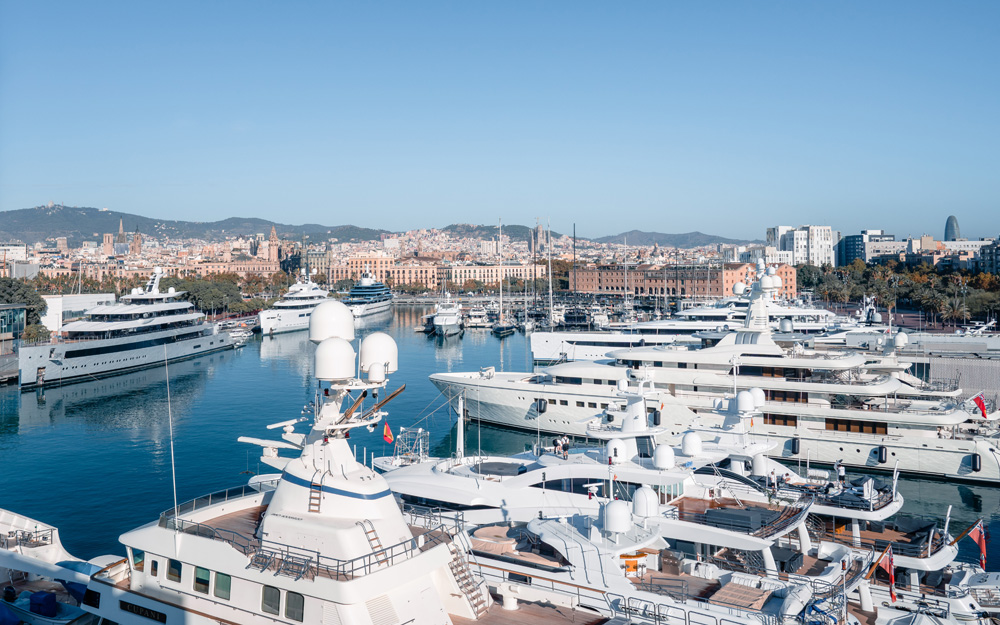
This is a crazy story, buckle up. I really enjoy walking across the Barcelona Port Vell marina: open space, palm trees, the water just a few meters away… a perfect place to unwind, reflect, and maybe sip a good cocktail.
It was late 2018, and I was walking there with one of my best friends. I had never really paid attention to the yachts berthed along the marina until I saw a massive one. So massive it covered the buildings behind it1. Its name was Dilbar, and it was the largest private yacht by gross tonnage at that time.
A few subsequent walks only deepened my curiosity. One night, I opened Wikipedia and started reading about the yacht charter business. In the Spanish article, there used to be a sentence that went something like this:
“Latest trends in the yacht charter industry involve implementing chatbots, machine learning, and artificial intelligence to customize the customer experience.”
I looked into applied machine learning in the sector, found nothing, and closed my laptop for the day. An idea was born: I would build an application to help charter agencies recommend the most suitable vessel for a customer based on their previous charter history.
The sensation of building something no one else had built felt amazing, but it came with a great responsibility: you have the power to set a standard, but at the same time, more capable people might be secretly working on the same thing. I had to move fast (I didn’t).
Anyway, I scraped the entire Yacht Harbour yacht database into a SQLite file (if you’re reading this, I’m sorry!) and plugged it into Python, only to decide Java was more suitable for my requirements a few days later.
Fast forward nearly two years, I had a piece of software that would fetch previous vessels from a database using JDBC, and then classify them in two ways:
- For quantitative attributes, such as length, width, number of rooms, and crew, it would look for similar vessels within n standard deviations, increasing n by one if no matches were found.
- For qualitative attributes, which were less relevant but still important (shipyard, interior and exterior designer), it would build a layered graph, traverse it recursively, and create tuples.
The result was a set of numerical attributes with qualitative tuples that were then used to query the database, producing a customized set of new vessels. In the end, the result was presented as a PDF created with HTML, including similarity percentages for each attribute.
The thing is, I did all of this for fun on my legendary ThinkPad T400, running an old version of Eclipse and with no previous knowledge of Java. While I was building it, I thought maybe it was worth showing around, so I cold-emailed several yacht charter agencies and even had calls with some of them.
In the end, I was offered an internship at Camper & Nicholsons, which I turned down for a better offer. The call was with their CTO at the time, Giovanni Alessi Anghini, son of Alessio Alessi, of the Alessi design family. Yes, the coffee machines. The software was no big deal in hindsight, but it has a special place in my heart because it set the foundations for everything else you’ll see on this website.
-
I found a picture from 2017 taken from the exact same spot where I saw it for the first time. Seems like someone else was impressed enough to post it on Wikipedia. ↩︎
